
What Craft Teaches That the Textbook Cannot: The Real Case Behind NEP 2020’s Bagless Days
A contributing voice from policy analysis | Specialist in education equity, school improvement, and teacher professional development
Planning, sequencing, problem-solving, and refining a physical object are substantial cognitive demands — largely invisible in a school system organised around written assessment. India’s own policy has caught up with this faster than most schools have: NEP 2020 mandates a 10-day “bagless period” for every student in Grades 6-8, spent interning with local carpenters, potters, gardeners, and electricians rather than sitting in a classroom. The research behind why this matters is real, though more measured than the strongest claims for it — and understanding exactly what it does and doesn’t show is what makes the case durable.
Key facts
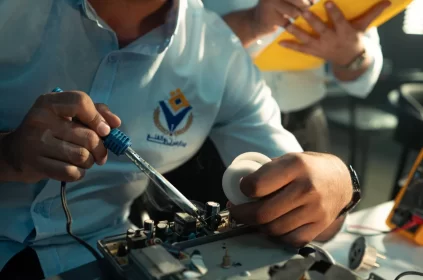
- NEP 2020 (para 4.26) mandates that every student take a 10-day bagless period sometime in Grades 6-8, interning with local vocational experts — carpentry, electrical work, pottery, gardening, metalwork — as decided by local skilling needs.
- NCERT’s implementation guidelines, developed by its vocational-education unit PSSCIVE, were only formally notified in July 2024, on NEP’s fourth anniversary — meaning most schools are still in the early years of actually running this, not a mature, settled practice.
- NEP 2020 also mandates that all students in Grades 9-12 receive vocational education in at least one vocation, integrated into mainstream schooling rather than offered as a separate track.
- A systematic review and meta-analysis found a statistically significant positive correlation between preschool children’s fine motor skills and academic outcomes, strongest for mathematics (r ≈ 0.47) — a real association, though a correlational one that does not by itself prove hand skill causes academic gains.
- Separate intervention research (Gilligan-Lee et al., 2023, Child Development) found that physical manipulatives used in spatial-skills training produced measurable improvements in children’s mathematics performance, offering more direct, causal-leaning evidence than the correlational fine-motor findings alone.
- NEP 2020’s Lok Vidya framework gives schools explicit policy backing to hire local artists and craftspeople as “master instructors,” addressing the staffing gap most schools face for this kind of teaching.
What the evidence actually shows — and where it stops
A child solving arithmetic without moving their fingers still shows activity in the neural regions tied to finger movement. The line between “hands-on” and “cognitive” is far blurrier than a written-exam-only school system assumes.
The strongest, most defensible version of this argument rests on embodied cognition research: physical, sensorimotor experience is not separate from abstract thinking but bound up with it, and interventions using physical manipulation have shown real transfer to specific academic skills — spatial reasoning and mathematics in particular. The fine-motor-skills meta-analysis adds a second, complementary line of evidence, though a more cautious one: it establishes correlation, not proof that craft work causes the academic gain, since children with stronger fine motor skills may differ in other ways too.
Taken together, this is a genuinely supportable case — just a narrower one than “working with your hands makes children smarter across the board.” The strongest, most specific claim the evidence backs is about spatial and mathematical reasoning specifically, not a blanket cognitive boost. That is still a meaningful, useful claim, and NEP 2020’s own bagless-day mandate does not require a stronger one to justify itself.
Five principles for making bagless days more than a compliance exercise
- Diagnose which local craftspeople and trades are actually available before designing the programme. A school near a pottery or weaving community has different options than one near mostly agricultural or construction trades; NEP 2020’s language explicitly ties vocational selection to “local skilling needs,” not a fixed national list.
- Treat the craftsperson-student relationship as mentorship, not a one-off demonstration. The internship model NEP 2020 describes is closer to apprenticeship than a single workshop — a sustained relationship over the ten days is what the policy actually envisions, not a visiting-speaker format.
- Build it into the regular calendar, not a single annual event. NCERT’s July 2024 guidelines frame bagless days as part of the ongoing teaching-learning process, explicitly not as an add-on — a school treating it as a once-a-year excursion is implementing a narrower version than the policy intends.
- Use Lok Vidya to formalise what many schools already do informally. Where a school already has an informal relationship with a local craftsperson, Lok Vidya gives a route to bring them in as a recognised “master instructor” rather than an unpaid favour.
- Start with the ten mandated days this cycle, not a bigger vision. Because national implementation guidelines only arrived in mid-2024, most schools have room to begin with the minimum viable version — one local craftsperson, one cohort, ten days — rather than waiting to design something more ambitious.
Frequently asked questions
What exactly are “bagless days,” in practical terms? A 10-day period, taken sometime during Grades 6-8, during which students leave the standard classroom and textbook schedule to intern with local vocational experts — carpenters, potters, gardeners, electricians, and similar trades — chosen based on what is locally available and needed.
Does working with your hands actually make children academically stronger, or is that overstated? The honest answer is mixed but real: intervention research on physical manipulatives shows genuine causal-leaning gains in spatial reasoning and mathematics specifically. The fine-motor-skills research shows a strong correlation with broader academic outcomes but does not establish that craft work alone causes it. Both are worth citing — as long as they’re not overstated into a blanket claim.
Are bagless days actually happening in most schools yet, or still mostly theoretical? Still early. NCERT’s implementation guidelines were only notified in July 2024, four years after NEP 2020 itself, so most schools are in the first few implementation cycles rather than having a mature, refined version of the practice.
How does a school fund or staff this without a formal craft-education budget? NEP 2020’s Lok Vidya framework is designed precisely for this: it allows schools to bring in local artists and tradespeople as recognised instructors without requiring a new formal teacher-recruitment process.
What to do:
- Identify which local craftspeople, tradespeople, or artisans are realistically available near your school, and match that list against NEP 2020’s bagless-day requirement for your Grade 6-8 students.
- Speak with one school or colleague who has already run a bagless-day cycle, and ask specifically what worked and what they would change.
- Read NCERT’s July 2024 bagless-days guidelines (PSSCIVE) directly, rather than a summary, and share one specific implementation detail with your headmaster this week.
- Propose using the Lok Vidya framework to formally bring in one local craftsperson your school already has an informal relationship with.
- Set a review date four weeks out to check whether your school’s bagless-day plan for this cycle actually moved from proposal to schedule, and write it down today.
Sources: National Education Policy 2020, Ministry of Education (para 4.26, vocational education and Lok Vidya); PSSCIVE/NCERT, Guidelines for 10 Bagless Days in Schools (July 2024); “Research progress on the relationship between fine motor skills and academic ability in children: a systematic review and meta-analysis”; Gilligan-Lee, K. A., et al. (2023), “Hands-On: Investigating the role of physical manipulatives in spatial training,” Child Development.