
What actually reduces exam pressure in Indian schools? CBSE’s new twice-a-year system, and what the research says works alongside it
CBSE has already begun holding Class 10 board exams twice a year, specifically to ease the weight of a single high-stakes test. Research on test anxiety shows what schools can do alongside that reform, and which common classroom habits work against it.
Nandini Rao | Specialist in education equity, school improvement, and teacher professional development
The stakes behind this topic are real and documented. The National Crime Records Bureau’s 2023 report recorded 13,892 student suicides in India that year, the highest count in a decade, and cited failure in examinations as a factor in 1,303 deaths among students under 18. Numbers like these are why exam reform in India is treated as urgent policy, not a routine adjustment to a timetable. Anyone reading this who is personally struggling can reach Tele-MANAS, India’s national mental health helpline, at 14416 or 1800-891-4416, free and around the clock.
What has CBSE actually changed about the exam itself?
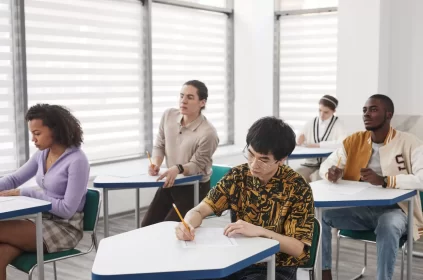
Starting this academic year, CBSE has restructured the Class 10 board exam around a principle test-anxiety researchers have long argued for: don’t make everything ride on one attempt. The first phase, held this year from 17 February to 11 March, is compulsory for all students. A second phase, held from 15 May to 1 June, is optional and lets students retake up to three subjects to improve their score, with the better of the two results counting toward the final mark sheet. CBSE’s own examination controller has described this explicitly as an effort to reduce exam stress, and the reform traces directly to NEP 2020’s call for flexibility and reduced weight on any single test. Special provisions exist for sportspersons, students with disabilities, and those in winter-bound regions to choose which phase suits them.
Does more frequent, lower-stakes testing actually reduce anxiety?
A 2023 meta-analysis of 24 studies found that low-stakes practice tests and quizzes didn’t just improve academic achievement. They also reduced students’ test anxiety.
The research suggests CBSE’s underlying theory is sound, and that it applies well beyond the board exam calendar. David Shanks at University College London and colleagues reviewed 24 studies measuring test anxiety alongside quiz and practice-test use, published in Educational Psychology Review in 2023, and found practice testing improved both learning and anxiety scores at the same time, provided the tests were low stakes, ungraded or retakeable, rather than a single decisive attempt. Shanks was careful to note this isn’t simply about competence reducing worry, since highly capable students report high anxiety too; the mechanism appears to be more about familiarity and reduced uncertainty than about mastery alone. This is the same logic behind giving a student two chances at a board exam instead of one, applied at the scale of a single classroom test rather than a national exam calendar.
What common classroom habits work against this?
Public evaluation and comparison do the opposite of what practice testing does. Research on classroom anxiety consistently finds that being singled out for evaluation in front of peers, cold-called to answer, or ranked publicly against classmates raises anxiety more reliably than almost any other classroom practice, and that this effect lands hardest on students already prone to worry rather than motivating them. One study of introductory science classrooms found that being called on to answer a question produced measurably higher anxiety than working in small groups, filling out worksheets, or answering anonymously through a clicker or show of hands, even though all four were nominally the same “active learning” activity on a lesson plan. A merit list pinned to a noticeboard, ranking every child in a grade against each other by marks, sits squarely inside what this research flags as harmful rather than motivating. The Supreme Court’s own 2025 guidelines on student mental health explicitly directed educational institutions to move away from batch segregation by academic performance and public shaming of low performers, for exactly this reason.
What to do
Add frequent, low-stakes practice quizzes and retrieval tests to your own classroom routine alongside the board’s twice-yearly structure, since the evidence shows this specific practice reduces anxiety while it improves learning.
Stop posting public rank lists that compare students by marks. If a list must go up, use ranges or categories rather than a numbered ladder from first to last.
Confirm that your students and their parents actually understand how the new two-phase Class 10 system works, the compulsory February exam and the optional May retake in up to three subjects, since a safety net nobody understands doesn’t reduce anyone’s pressure.
Make sure Tele-MANAS and your school counsellor’s contact details are genuinely visible, on noticeboards and in classrooms, not filed away as a compliance requirement nobody has looked at since it was printed.
Watch specifically for withdrawal, physical complaints, or avoidance building in the weeks before an exam period, and route a student to the counsellor early, rather than waiting for a crisis to force the referral.
Sources: National Crime Records Bureau, “Accidental Deaths and Suicides in India 2023” · CBSE notification on the two-phase Class 10 board examination system (2025-26 academic year) · National Education Policy 2020 · Shanks et al., meta-analysis of practice testing and test anxiety, Educational Psychology Review (2023) · Research on classroom evaluation anxiety and public comparison in academic settings · Sukdeb Saha vs State of Andhra Pradesh & Ors, Supreme Court of India (25 July 2025), guidelines on academic pressure and batch segregation · Tele-MANAS National Tele Mental Health Programme, Government of India (helpline 14416 / 1800-891-4416)