
Online Safety in the School Age: What the Data Shows — and What Schools Are (Finally) Doing About It
A contributing voice from educational research | Specialist in curriculum, pedagogy, and school leadership
India’s school-aged children are now among the most connected in the world, and the data on what that connection costs them is specific rather than speculative: a 2026 survey of nearly 90,000 parents found half report their child faced online risks or inappropriate content in the past year, and nearly 4 in 10 young people spend more than four hours online daily. Schools genuinely have not kept up historically — but that is changing faster than the general policy discourse suggests, with a national mandate landing as recently as this year.
Key facts
- A LocalCircles survey of nearly 89,000 parents across 302 districts, published February 2026, found 1 in 2 parents of children aged 9-17 reported their child faced online risks or inappropriate content in the last 12 months.
- UNICEF’s 2024 U-Report survey found 40% of young people in India spend more than four hours online daily — a scale of exposure that increases both digital-skill development and vulnerability to risk.
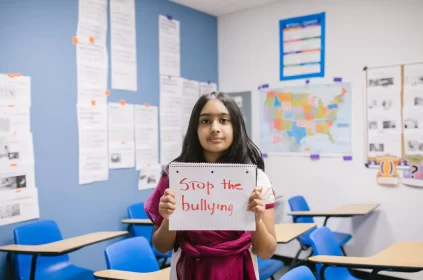
- A study of 484 adolescents in Grades 8-12 at a South Indian school found roughly half had experienced online bullying in one role or another — as target, initiator, or bystander — with involvement increasing with grade level.
- National Crime Records Bureau data found cybercrime targeting children spiked 261% during India’s first pandemic lockdown, with online stalking the single most common category reported.
- As of 2026, CBSE has mandated a 2.5-hour cyber hygiene certification course for students, teachers, and parents across all affiliated schools, alongside mandatory school-based “cyber clubs” and a recurring monthly awareness day, “Cyber Jagrookta Diwas” — a concrete, very recent national response that meaningfully updates the “schools aren’t keeping up” framing, even as implementation is still new.
The gap is real, and it’s closing faster than the general narrative suggests
A 261% spike in reported cybercrime against children during lockdown is not a slow-moving policy failure — it is the kind of number that explains why a mandatory national certification course landed this year rather than staying a proposal. The honest story is less “schools are ignoring this” and more “the response arrived late and is still catching up to the scale of the problem.”
This distinction matters for how a school should act now. NCERT released its Cyber Safety and Security Guidelines in 2025, and CBSE’s mandatory certification course, cyber clubs, and recurring awareness day followed in 2026 — both genuinely recent, both genuinely national in scope. A school assessing its own position should be asking not “does a resource exist” but “have we actually implemented what already exists,” since the implementation gap, not the policy gap, is now the more likely place to find room for improvement.
Five principles for closing the gap at school level
- Diagnose which specific online risk is most relevant to your students, rather than “online safety” broadly. NCRB data points to stalking as the dominant reported category; separate research on peer dynamics points to bullying, with involvement rising through the grades — these call for different responses, not one generic digital-literacy session.
- Build the trusted-adult relationship that makes disclosure possible. The bullying research specifically documents bystander roles as common and significant — meaning peer culture, not just individual victimisation, is part of the mechanism, and a school’s relational climate shapes whether either victims or bystanders speak up.
- Use the recurring structure CBSE has already built, rather than a single certification and done. The mandate’s monthly “Cyber Jagrookta Diwas” model reflects the same evidence base as other school-improvement research in this series: sustained, recurring engagement outperforms a one-time session.
- Include parents directly, since the CBSE mandate already does. With only about half of parents in the LocalCircles survey aware their child had faced a specific online risk in the past year, family engagement is not a nice-to-have addition — it’s built into the current national course design for exactly this reason.
- Start by auditing what’s already mandated before requesting something new. Since NCERT’s guidelines and CBSE’s certification requirement already exist, the fastest, lowest-cost first step for many schools is checking whether the mandated course, cyber club, and awareness day are actually running — not designing a parallel programme from scratch.
Frequently asked questions
How much time are Indian children actually spending online, and is most of it risky? Substantial exposure, not uniformly risky: 40% of young people report more than four hours online daily (UNICEF, 2024), and separately, half of parents surveyed report their child faced a specific online risk or inappropriate content in the past year — meaning heavy use is common and risk exposure is common, though not every hour online translates to a harmful encounter.
What’s the most common specific online risk facing Indian schoolchildren? It depends on the data source: NCRB crime data points to online stalking as the leading reported category, while separate adolescent-focused research finds cyberbullying — in victim, perpetrator, or bystander roles — affecting roughly half of surveyed students, rising through the grades.
Is anything actually being done about this at a policy level, or is it still just discussion? Genuinely current action: NCERT issued national cyber-safety guidelines in 2025, and CBSE mandated a certification course, school cyber clubs, and a recurring monthly awareness day in 2026 — both real, recent, and national in scope, not proposals still under discussion.
What can a school do this week without waiting for external support? Check whether the CBSE-mandated cyber hygiene course, cyber club, and Cyber Jagrookta Diwas schedule are actually running at your school — since these are already required rather than optional, the fastest improvement available to many schools is closing an implementation gap, not building something new.
What to do:
- Identify which specific online risk — stalking, bullying, inappropriate content exposure — is most reported or observed among your own students, rather than treating “online safety” as one undifferentiated issue.
- Speak with one colleague or school actively running its cyber club or Cyber Jagrookta Diwas sessions, and ask specifically what content and format is landing with students.
- Read NCERT’s 2025 Cyber Safety and Security Guidelines or CBSE’s cyber safety manual directly, and share one specific finding with your headmaster this week.
- Confirm whether your school has actually implemented the CBSE-mandated certification course, cyber club, and monthly awareness day, and propose restoring or starting whichever is missing.
- Set a review date four weeks out to check whether the specific step was implemented and whether students or parents noticed any difference, and write it down today.
Sources: LocalCircles survey via The Week, “Cyberbullying in India: 1 in 2 parents say kids face online abuse or inappropriate content” (February 2026); UNICEF, “2026 Guidance Note: Online Safety in Education,” citing 2024 U-Report survey; adolescent cyberbullying study, PMC (South India, Grades 8-12); National Crime Records Bureau data via NortonLifeLock/Save the Children reporting; CBSE cyber hygiene certification mandate, via Whalesbook (2026); NCERT Cyber Safety and Security Guidelines (2025).